Owner's Helm: Vessel Readiness & Passage Planning
Helm is NAVOPLAN’s operational layer for owner-operators and crew. It supports the vessel before departure, throughout the passage, and when conditions change.
The goal is not more systems to manage. It is clearer decisions, fewer missed details, and preparation that holds together in the real world—including a fully automated Digital Float Plan with Active Vessel Tracking that can be generated from the passage itself rather than assembled under pressure.
Membership Foundation
Helm brings together the areas that most directly affect how a passage actually goes: vessel readiness, phased passage planning, digital float planning, and emergency coordination. The intent is simple—to help the captain and crew achieve safer passages.
Vessel Readiness
Build a complete picture of your boat—systems, spares, and history—so you’re always ready for what’s next.
Passage Planning & Support
Plan and organize each passage from start to finish. Upload routes, prepare details, and track readiness before departure.
Digital Float Plan
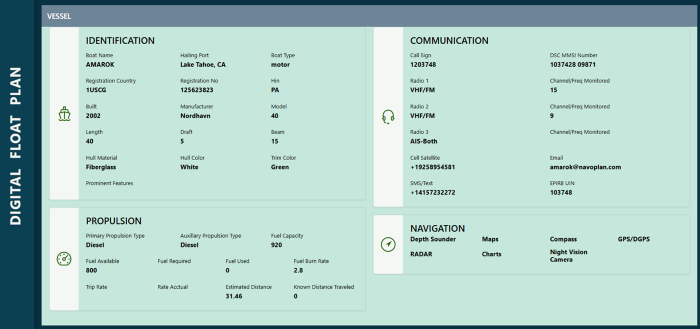
Automated real-time digital float plans communicating vessel, crew onboard, system, safety devices, planned track and actual route.
Ship's Log
Capture and review passage logs, notes, and events—automatically or manually—so nothing gets lost.
Checklists & Tasks
Manage recurring tasks and structured checklists to keep the vessel running consistently and safely.
Ship's Calendar
Track passages, maintenance, and key dates in one place—so you always know what’s coming up.
Bluewater Briefings
Focused briefings covering the questions, tradeoffs, and realities most future cruisers encounter when preparing for safer passages.
Bluewater Roundtable
Subscriber discussions shaped by real questions, experiences, and decision points from people actively exploring the lifestyle.
Captain’s Minutes
Monthly minutes with NAVOPLAN (never expire) for focused 1-on-1 sessions for any topic.
FIRST-MATE Case
FIRST-MATE Case allows you to work through virtually any cruising, vessel, or operational question.
Emergency Assistance Coordination
Request immediate support when something goes wrong—so you’re not handling it alone.
Active Passage Tracking
Your vessel is monitored in real time—if something changes or goes quiet, it gets attention.
Vessel Website & Blog
Share your travels with a vessel website and blog. Drag your photos to the page and publish.
Vessel Readiness
A passage rarely comes undone because of one dramatic issue. More often, it is a collection of smaller things that were not tracked, documented, scheduled, or resolved in time.
Vessel Readiness gives the owner-operator a structured way to manage the boat as a working platform. It centralizes maintenance history, digital vessel documents, vendors, parts, tools, supplies, and repeatable onboard processes.
- Routine maintenance tracking and scheduling
- Repository for digital vessel documents and manuals
- Vendor management, pricing requests, and work tracking
- Parts, tools, and supply tracking
- Checklist functionality to document onboard processes
- Configurable to reflect vessel layout and existing processes
Over time, this becomes a working record of the vessel that supports better upkeep, easier shore-side coordination, and clearer operational continuity.
Phased Passage Planning & Support
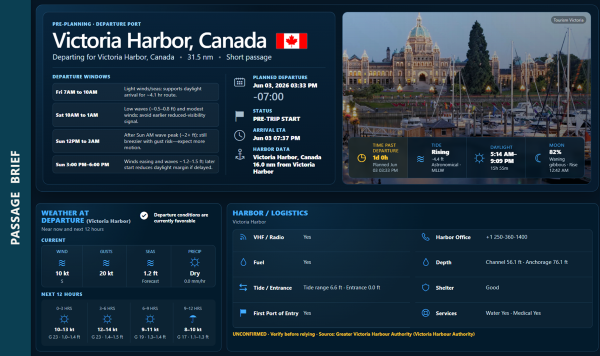
Every passage has a rhythm. Helm organizes that rhythm into five stages: planning, departure, underway, arrival, and completion.
Captains can initiate an upcoming passage with a GPX route, then work through each phase with a living Passage Brief that accompanies you on the passage. Checklists, crew documentation, inspection and watch support, scheduling, and route monitoring also support the crew in achieving a safer passages.
That same passage setup also supports one of Helm’s most practical safety advantages: the Digital Float Plan. Instead of relying on someone ashore to remember the boat, the route, the timing, and when to call for help, Helm can generate a current float plan directly from the voyage data already being used to manage the passage.
- Initiate upcoming passages with a GPX file
- Editable checklist library for each phase
- Periodic inspection and watch monitoring
- Crew assignment and documentation support
- Passage and vessel calendar
- Route monitoring with passage stats and tracking
- Digital Float Plan generated from the planned passage
The point is not to replace judgment. It is to support consistency, preparation, and follow-through so the crew can focus on the passage itself.
Emergency Assistance Coordination
When something goes wrong offshore, the problem is rarely just the event itself. It is the delay, the uncertainty, and the loss of context around what was planned versus what is actually happening.
Helm addresses that by linking a planned route with the actual vessel track and supporting shore-based monitoring through the vessel’s existing communications setup. The Digital Float Plan provides a current record of the route, tracking status, last known position, and last contact time, so if something changes there is no need to reconstruct critical facts from memory.
- Create a NAVOPLAN passage and set it underway
- Start geolocation tracking
- Support tracking via Starlink-connected devices
- Support tracking via satellite SMS messaging
- Digital Float Plan tied to the planned passage and current voyage status
- Last known position and last contact time available when needed
- Compare the actual vessel track against the planned route
- Coordinate with available resources if assistance is needed
NAVOPLAN does not provide search, rescue, medical, or on-site services. The role is shore-based monitoring and best-effort coordination using the information already in place.
Digital Float Plan
Most boaters do not prepare a float plan before departure. When something goes wrong, that often means rescue personnel depend on friends or family to remember details they may not have, or may not communicate quickly enough.
Helm reduces that gap by generating a Digital Float Plan directly from the planned passage. By starting with the GPX route and passage data already in use, NAVOPLAN can maintain a current float plan with voyage details, tracking status, last known position, and time of last contact.
That matters because it can narrow uncertainty dramatically. Instead of beginning with scattered recollections and delayed awareness, assistance can begin with a much clearer picture of where the situation likely changed.
Sample FIRST-MATE Case Scenarios
Routine Maintenance Decision
A service interval is approaching before departure. What needs to be checked, scheduled, documented, and resolved before the boat is truly ready?
Passage Preparation Problem
Crew roles, documentation, checklists, and timing are not fully aligned before departure. How does Helm help pull the plan together?
Unexpected Issue Underway
A mechanical concern, communications interruption, or delayed check-in develops during a passage. How is the situation understood and how does coordination begin?
Achieving Safer Passages Starts Here
Preparation is freedom. Our purpose is clarity.
We help you make informed, confident decisions at every stage. Helm exists to support the operational side of that promise—before departure, underway, and when something changes.
Because safer passages are rarely the result of one good decision. They come from a system that holds together when it matters.